Detailing packages and pricing: how to build a price list that sells
How to build detailing packages and a price list from your real costs, and how to get paid more for PPF and ceramic coating without discounting.

The short answer
Build 3 detailing packages per service and present the best one first. Price each one from your real hours and costs, which gives you a floor, and let your value proposition decide how far above it you charge. Customers who say you're too expensive usually can't picture what they're getting, so fix the package and never discount the same work.
You hand a customer a quote for a full front, and they come back with “the other shop quoted me less.” After enough of those, it’s tempting to rebuild your detailing packages around whatever the cheaper shop charges. I wouldn’t, because when I dig into those lost jobs, the price is usually fine.
Between Detailing Growth and Detailer OS, we’ve crossed 1,400 conversations with shop owners. The line I hear most is that they get the leads but can’t close them, because every customer pushes back on the price. What goes wrong happens right after the pushback, when the owner panics and either talks too much or drops the number. A menu built the right way gives you somewhere to stand in that moment.
Talkin’ Paint is the podcast I host for detail, PPF, ceramic coating and window tint shop owners, and I’ve said the same thing about pricing on it since 2022: selling on price is stupid. The customer is buying a feeling, and your value proposition decides what you get to charge for it.
Why do customers say your detailing pricing is too high?
They say it because they can’t picture what they’re getting for the money, so their brain picks the safe answer, which is no. I called it a frame problem on The Customer Bought The Car For A Feeling. The number can be right and the customer still walks, because nobody built a picture around it.
A customer who walks in for an oil change knows what an oil change costs. They’ve done it 20 times. They have a number in their head before they walk in. When the kid at the counter says 79 bucks, the customer just pays. That same customer is now walking into your shop. You quote them around two grand for a full front PPF. They got nothing. No memory of buying this before. No number in their head, no frame for what two grand worth of paint protection film is supposed to feel like.
On that episode I gave the 3 reasons behind almost every price pushback. The customer doesn’t understand what they’re buying and hides behind price so they don’t look dumb asking, or they’ve got a cheaper quote from a shop they don’t fully trust, or they’re scared because once the film is on the car the money is spent. A package that tells them in plain words what happens to their car answers all 3, which is why I build the menu before I touch a price.
How many detailing packages should you offer?
Offer 3 per service, plus a short list of add-ons. My PPF clients get 3 options, a full front, a track package and a full body, and I steer them toward the one that makes sense without overselling. Every option past 3 gives the customer another reason to wonder if they’re picking wrong, and 3 clear packages with your recommendation takes that worry away.
Present them best first. In my sales process tutorial I call it the reversed good, better, best spread. The best package anchors the conversation, and even the customers who say they don’t want it usually still want it, so the other 2 look reasonable sitting next to it.
Before you write a package, do the exercise from the CVP episode. Write down 10 things your customer cares about and 10 things you care about, then see where the lists overlap. Your list probably has your favorite pad and polish combo on it, and only the customer’s list belongs in the package descriptions.
What goes in each tier of a detailing package?
Each tier should be a real step up in what physically happens to the car, plus one tier that exists so you can lower a price without discounting. The PPF column is what I sell. The coating column follows the same shape, described by what changes between tiers, because coating names depend on the brand you carry.
| Tier | PPF | Ceramic coating | Why it’s on the menu |
|---|---|---|---|
| Best (show it first) | Full body, every painted panel | Your longest-warranty coating on paint, plus glass and wheels | It anchors the price talk for everything below it |
| Better | Track package: full front plus rockers or lower doors, the area behind the rear wheels, sometimes the A-pillars | A mid-level coating on paint and glass | Daily drivers that see highway miles |
| Good | Full front: whole hood, fenders, bumper and mirror caps, with headlights and fogs thrown in | Your entry coating on paint | The least you’ll put your name on |
| Down-package | Partial front: front third of the hood and fenders, plus the full bumper | Fewer surfaces and a shorter warranty | How you come down on price by changing the work |
| Add-ons | Door edges, door cups, headlights | Interior, glass, wheels, a coating over the film | Cross-sells after the main choice is made |
Write every description with the result first, like a car that doesn’t need polishing every spring, or a trade-in number that holds up because the paint still looks new. The specs come after, to back the picture up.
A lot of shops leave out the down-package, and it’s the tier that protects your pricing. A partial front done right still covers the panels that take the damage, so you can offer it with a straight face when the budget is tight.
How do you price detailing so the numbers work?
Start from what the job costs you: hours on the car times what an hour costs you, plus materials, plus the margin you want. That math gives you a floor, and your value proposition decides how far above the floor you price.
These are example numbers for a full detail on a midsize SUV, to show the method. They aren’t a market rate for anywhere, so swap in your own.
| Line | Example | How to get your real number |
|---|---|---|
| Hours on the car | 4 | Time 3 real jobs and average them |
| Labor cost per hour | $30 | What you pay the tech, plus payroll taxes |
| Overhead per hour | $31 | Monthly fixed costs divided by billable hours ($5,000 / 160) |
| Labor and overhead | 4 x $61 = $244 | Hours times both hourly costs |
| Materials | $25 | Product used up on that car |
| Your cost | $269 | The least this job can ever sell for |
| Price at a 40 percent margin | $269 / 0.6 = about $450 | Cost divided by 1 minus your margin |
Overhead is the line people forget. Add up a month of rent, insurance, utilities, software and marketing, and divide it by the hours your team actually bills. Pick your margin on purpose and write it down. For PPF, I said on Getting Started in PPF that margins can run 75 to 80 percent after materials and labor.
When Jeremy Harding from Nasiol USA came on, I asked what drives him nuts about this industry, and he went straight to shops racing to the bottom against side hustlers quoting $100 details.
If you drop your prices to try to compete with them, no, that’s not going to work. The only thing you’re going to do is make sure that you slowly run yourself out of business as well. Know your value, know your worth. If you don’t know your numbers, you can’t set your pricing accordingly.
Mobile detailing prices run on the same math with one change, because the drive is part of the job. If you spend 45 minutes getting to a car and setting up, those 45 minutes go in the hours line, since you can’t sell them to anyone else that day.
Time your real jobs before you trust any of this. When I wrote our ceramic coating process down step by step, I found 3 steps that were costing us time, and our guide to detailing SOPs and checklists shows how to do the same in your shop.
What should a detailing price list look like?
It’s one grid, with your packages down the side and vehicle sizes across the top, so cars, midsize, SUVs and trucks each get their own price. The customer sees their exact vehicle on it, and whoever answers your phone quotes the same number you would.
On the honesty episode I said a transparent pricing model like this gets you faster closes, and customers pick the better package more often because they can see it laid out for their kind of vehicle. In episode 34 I said reps won’t underquote if you give them a pricing structure they can follow without guessing. Pay whoever manages sales on margin and close rate, because a manager paid on total revenue pushes the team to close low-margin work just to fill the calendar.
On a call, the customer hears the grid in a different order: questions about the car first, then the best package. The full first-call script is in our article on the detailing sales process.
How do you charge more for PPF and ceramic coating?
You earn a higher price with proof the customer can check for themselves. Show them who installs the film and what the warranty covers, and show them how you document the car and look after them once it’s done. Then price the vehicle itself.
When I recorded Getting Started in PPF in late 2022, I gave this price structure for shops getting started. Treat it as a reference from that year, because your 2026 market and costs won’t match it.
| PPF package (late 2022) | Range I gave |
|---|---|
| Partial front | $800 to $1,300 |
| Full front | About $1,800 to $2,500 |
| Track pack | $2,500 to $3,500 |
| Full car | $5,500 to $10,000 or higher |
| Corvette C8 full body (our set price) | $9,450 |
| Door guards, door cups, headlights | $100, $200, $200 to $300 |
We set full-body prices by model, and the C8 sat well above our Tesla price because it’s a different level of install. A Honda Civic owner probably isn’t spending $2,500 on a front end, and a Porsche owner is likely to see more value in the same work, so let the price reflect the car.
On the episode with Robert Winters of Phenomenal Detailing, we talked through a Rivian PPF job that sold for $14,000. The price got posted in Facebook groups, and a lot of people in the industry got upset about it. The customer had told the shop it was almost double everyone else’s price, and the reply that won the job went in this order.
- Acknowledge the gap without apologizing: “Totally understand, this is not an apples to apples comparison.”
- Expertise, put in terms the customer could picture. The shop’s installer had a decade on film, including hypercars worth millions overseas.
- The product, with facts. The other shop wasn’t an XPEL dealer and planned to put its own coating on the film, so the reply included the XPEL warranty language saying another coating voids it.
- Service over the sale. The reply said the shop wanted the job, and if he went somewhere else, it wanted him to have a good experience there.
- His real worry, which was the installer cutting into the paint. That’s usually a problem for newer installers, and it goes away with time and experience.
All of it went out in one long, plain email. The customer wrote back that nobody else had taken the time to educate him or answer his questions, the deposit came in about 20 minutes later, and once the car was in the shop he added tint and a windshield on his own.
Robert’s shop builds trust in the same places. Every PPF customer comes back after 30 days so the shop can check the film, and every car gets photographed and noted at inspection. On that episode, a Range Rover that came in only for coating left with a full front, because the inspection photos showed chips the owner hadn’t noticed.
That’s what I’ve always been known for, is the guy that’ll be an hour talking to you about something you might never even buy anything from me, but because I will make sure you got educated. Being a leader in the education part of it helps sell a lot of stuff.
Ceramic coating gets priced higher the same way. Match the coating to how the car lives, because it doesn’t make sense to pitch a lifetime-warranty coating on a car that sits in a garage and gets driven 2,000 miles a year. Then put the aftercare inside the package where they can see it: care instructions, the warranty paperwork, a 2-week follow-up appointment booked at pickup and a yearly coating check.
I won’t hand you a coating number for your town, because your prep time and your market decide it. Run the worked example on your real coating hours with the polishing in them. On episode 32 we talked about a $2,500 coating job a shop lost to the shop down the street that had a process video or a faster callback.
Should you ever discount a detailing package?
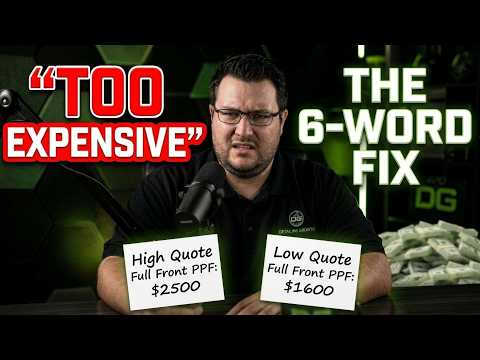
No. If the customer can’t afford the package you quoted, change what’s in the package and charge the price of the new one.
Every time you drop your price to save a deal, you train the next customer to come at you the same way. The customer leaves and tells his buddy he got you down 200 bucks, and next week the buddy walks in and the first thing out of his mouth is “what’s the best you can do?”
When someone says it’s too much, soften it with “yeah, I get it, this is a real investment,” then ask “compared to what? Specifically, though?” and stop talking. Their answer tells you what they’re measuring you against, whether that’s a cheaper shop or doing nothing at all, and the sales process article covers what to say to each one, including the customer who can’t answer.
If they still can’t swing it, the down-package earns its spot. I had a referral with a 2023 Corvette C8 looking at $10,000 in work, and after more than a week of follow-up he told me he was uneasy spending that much. We booked him on a slightly lower package, he thanked me for being patient, and the price of each package stayed exactly where it was.
So next time you’re tempted to undercut a price, think about what you could be providing in long-term value in that of a great experience. The correct client you want will be ready to pay what you’re asking. Price is only an objection to the uneducated consumer who doesn’t understand what they’re paying for.
What should you change on your menu this week?
Pull up your menu tonight and count the options for each service. If there are more than 3, cut down to 3 and add a down-package. Then rewrite each description so the result comes before the specs, and time 3 real jobs on your most popular package to check that your price clears the floor from the worked example.
Cutting options will cost you something. You’ll lose the shopper who wanted to build a custom package from 6 line items, and you’ll have to stop matching the shop down the road when someone mentions their number. I think that’s a trade worth making, because the customers who stay are the ones who send you their friends.
If you only listen to one episode on this, make it The Customer Bought The Car For A Feeling, then How We Charge More For PPF with Robert. If you’re adding film for the first time, our guide on starting a PPF business picks up from here, and the rest of the show is in the episode archive.
Questions shop owners ask
How many detailing packages should a shop offer?
I use 3 per service, plus a few add-ons. For PPF that's a full front, a track package and full body, with a partial front held back as the way to lower a price without discounting. Every extra option gives a customer one more reason to worry they're picking wrong, and 3 clear packages with your recommendation lets them decide.
How much should I charge for PPF?
When I recorded Getting Started in PPF in late 2022, I put a full front at about $1,800 to $2,500, a track pack at $2,500 to $3,500 and a full car at $5,500 to $10,000 or more, depending on the market. Use those as a reference from that year, then price the vehicle's value and how hard the install is on top.
How much should I charge for ceramic coating?
Price it from your own hours, including the wash, decon and polishing, plus the coating, the materials and your overhead, then add the margin you want. Build 3 tiers, each with more coverage and a longer warranty than the one below it, and match the tier to how the car gets driven. A garage car that sees 2,000 miles a year doesn't need your lifetime coating.
Is it ever OK to give a detailing customer a discount?
Lower the price only by changing the package. If someone can't afford the full front, offer the partial front at the partial front price. Taking money off the same package tells the customer your first number was made up, and every friend they send you walks in asking for the best you can do.